
Poor quality data can lead to a range of negative impacts on a business, including financial losses, missed opportunities, and reputational damage.
Inaccuracies, inconsistencies, and inadequate maintenance or security can result from various factors, including human error, system issues, data integration challenges, and more.
According to Gartner,
“Every year, poor data quality costs organizations an average of $12.9 million.”
Ready to Tackle your Data Challenges Head-on?
Secure a complimentary data quality session with our experts
Facing These Challenges?
Identify your top data quality challenges & receive guidance on tailored solutions.
Infocepts: Your Partner in Data Excellence
Our data quality services prioritize the importance of high-quality data in achieving business success – ensuring your data is clean, reliable, accessible, secure & trustworthy – guaranteeing its value to support your business.
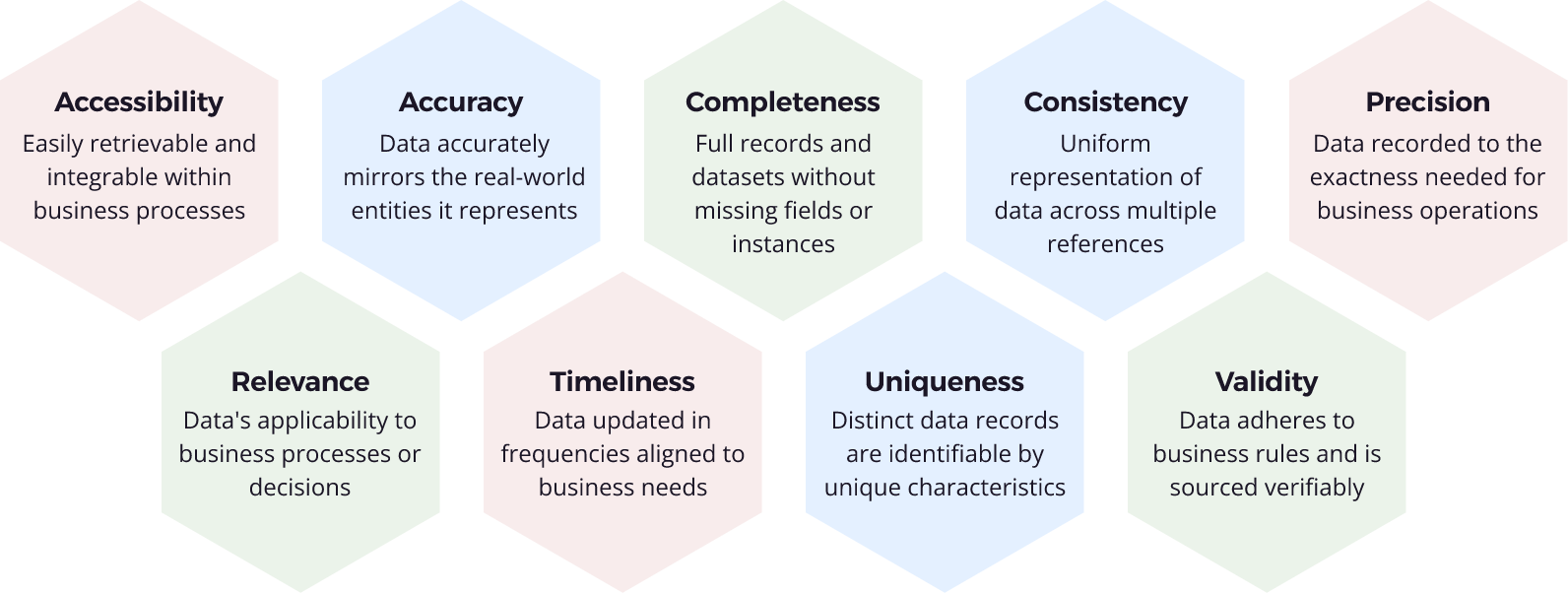
Our Data Quality Framework assess 9 critical dimensions, tailored to your specific needs, covering various data aspects such as tables, structured, unstructured, real-time, or batch processing. We customize our data quality services for different datasets and use cases, prioritizing data quality where it’s most crucial for your organization.
Reliable Data, Real Results: The Infocepts Approach
Our approach to data quality involves five broad steps.
Data
Profiling


We delve into your data, examining structure, content, and relationships to unearth potential quality issues. We use column-based and rule-based profiling to ensure alignment with business logic.
DQ
Analytics
We provide user-friendly dashboards that offer a clear view of data quality status and pinpoint potential errors. We employ advanced analytics for proactive data quality management.
Validation
& Cleansing
We improve data quality at the source to save time and costs, implementing validation checks aligned with business rules for key elements like addresses, birth dates and social security numbers.
DQ
Monitoring
Data quality is an ongoing journey. We implement continuous monitoring, tracking data quality progression and ensuring real-time adherence to business rules and handling of exceptions.
Change
Management
When data, business rules, or processes change, we follow strict change management protocols, including clear guidelines and robust rollback solutions for seamless transitions.

Infocepts’ data governance expertise is unmatched. Their data quality solution elevated our data integrity, reduced complaints, and empowered us to make more confident, intelligent business decisions.
Director of Data Analytics
Global Pharma Company

Elevate your Data Quality
FAQs
What does poor data quality actually cost a business?
Bad data leads to financial losses, missed opportunities, and reputational damage, and it typically stems from human error, system issues, and data integration challenges. Gartner estimates that poor data quality costs organizations an average of $12.9 million every year, underscoring why proactive data quality management is a business priority, not just an IT concern.
What does Infocepts’ Data Quality Framework cover?
The framework assesses data across 9 critical dimensions, tailored to the specific data types involved — structured, unstructured, real-time, or batch — so the approach can be customized to different datasets and use cases. This lets Infocepts prioritize data quality efforts where they matter most for a given organization, rather than applying a one-size-fits-all check.
What are the five steps in Infocepts’ data quality approach?
The approach runs through Data Profiling (examining structure, content, and relationships using column- and rule-based profiling), DQ Analytics (dashboards and advanced analytics for proactive monitoring), Validation & Cleansing (fixing issues at the source against business rules for elements like addresses and birth dates), DQ Monitoring (continuous, real-time tracking and exception handling), and Change Management (structured protocols and rollback plans when data, rules, or processes change).
What is Infocepts AQuA, and how does it improve data quality testing?
AQuA (Automated Quality Analyzer) is Infocepts’ data quality profiling and test automation tool that validates data across the entire pipeline, from source to consumption. It’s especially useful during platform migrations and upgrades or for ongoing production monitoring, expanding test coverage and automating repetitive test runs to speed up testing, cut costs, and improve accuracy compared with manual QA.
How is data quality different from data governance, and does Infocepts offer both?
Data quality focuses on making data accurate, complete, and reliable (profiling, cleansing, monitoring), while data governance focuses on the policies, roles, and accountability structures that keep data trustworthy over time. Infocepts offers both as related services, and describes its data quality work as tied closely to its broader data governance expertise, so the two are typically implemented together for lasting data integrity.
What business outcomes can organizations expect from investing in data quality management?
Clients report elevated data integrity, reduced customer complaints, and more confident, intelligent business decision-making. Because Infocepts customizes its data quality dimensions and validation rules to each organization’s specific data challenges, the approach aims for measurable improvements in reliability rather than generic clean-up.
Infocepts