
Brand Safety Is the Baseline. Emotional Context Creates the Opportunity.
Ask a media buyer what they mean by brand safety and brand suitability, and you’ll likely hear a familiar answer: we don’t want our client’s ad running next to inappropriate content.
For media publishers, brand suitability is becoming a key differentiator for contextual advertising, premium inventory packaging, and long-term publisher monetization.
That’s a reasonable expectation. But today, brand safety has become table stakes. Nearly every premium publisher has invested in processes, policies, and technologies to ensure brand-safe environments. Simply being “safe” is no longer enough to differentiate your inventory or justify higher CPMs. This challenge is explored further in our blog, The $40 Million Revenue Leak Most Publishers Don’t Know They Have.
As contextual advertising evolves beyond traditional brand safety and brand suitability, publishers are increasingly focusing on brand suitability to create premium advertising environments. By understanding the emotional context of content, media publishers can improve advertiser confidence, strengthen contextual targeting, and increase premium CPMs.
For media publishers, the opportunity is no longer limited to protecting advertising environments. It’s about using emotional context as a measurable signal to create differentiated inventory and stronger monetization opportunities. They can show advertisers how their content influences audience emotion, how that emotional context aligns with campaign objectives, and why certain placements deserve a premium over others.
That’s where sentiment intelligence changes the economics of media monetization.
Instead of treating every brand-safe impression as equally valuable, publishers can identify the emotional context surrounding every ad opportunity and package that intelligence into a differentiated commercial offering.
In short, sentiment intelligence shifts the conversation from simply protecting inventory to increasing its commercial value.
The Emotion in the Room: Why Two Brand-Safe Placements Aren’t Equal
Imagine two advertising placements.
Both reach the same demographic. Both air during primetime. Both meet every traditional brand safety and brand suitability standard. On paper, they appear identical.
Now consider the viewing experience immediately before the commercial break.
The first ad appears during a crime drama. The protagonist is in immediate danger, tension has been building for nearly an hour, and viewers are emotionally invested as the break begins.
The second ad appears during the finale of a cooking competition. A contestant the audience has supported throughout the season has just secured a major win, creating a mood that is optimistic, celebratory, and uplifting.
Both placements are brand safe – but they create completely different emotional environments.
For brands built around trust, family, celebration, aspiration, or optimism, the second placement naturally provides a stronger context for their message than the first.
Media buyers have understood this intuitively for years. Editorial judgment, historical campaign performance, and experience have long guided decisions about emotional alignment. The challenge has never been recognizing that emotion matters – it has been measuring it consistently across thousands of hours of content.
That’s exactly what SentimentVista AI enables.
Instead of relying on intuition, media publishers can quantify emotional context, demonstrate its value to advertisers, and monetize it as a premium inventory signal.
Why Brand Suitability Matters for Publisher CPMs
Traditional contextual advertising helps advertisers understand where an advertisement appears.
Sentiment intelligence tells them how the audience is likely to feel when it appears.
That difference transforms contextual targeting from a placement decision into a performance strategy.
And that’s a conversation advertisers are increasingly willing to pay for.
What Content Intelligence and Sentiment Analysis Actually Measure
Sentiment intelligence goes beyond identifying what content is about. It helps media publishers understand how content is likely to make audiences feel-and why that emotional context matters to advertisers.
While traditional contextual advertising classifies content based on topics and keywords, sentiment intelligence adds another layer by understanding the emotional context behind that content, helping publishers deliver more suitable advertising environments. This strengthens contextual targeting by helping advertisers understand not only what the content is about, but also how audiences are likely to experience it.
SentimentVista AI analyzes content at multiple levels, including the program, episode, segment, and break position, to build a comprehensive emotional profile across the viewing experience.
Metadata generated through ContentIQ enriches sentiment analysis by providing structured content intelligence across media assets. Rather than reducing content to a simple positive or negative score, it evaluates several dimensions that influence advertising effectiveness:
- Emotional Valence: Does the content evoke positive, negative, or neutral emotions?
- Emotional Intensity: How strongly is that emotion likely to be experienced?
- Emotional Stability: Does the emotional tone remain consistent, or does it shift significantly throughout the narrative?
- Brand Affinity Index: How closely does the emotional profile of the content align with the positioning of specific advertiser categories?
The result is far more valuable than a traditional “safe” or “unsafe” classification. Publishers gain a dynamic understanding of their inventory, enabling advertisers to identify placements that not only protect their brands but also strengthen campaign relevance and impact.
For media organizations, this transforms content from inventory into an intelligent commercial asset-one that can be packaged, differentiated, and sold with greater confidence.
How Brand Suitability and Contextual Targeting Drive Premium CPMs
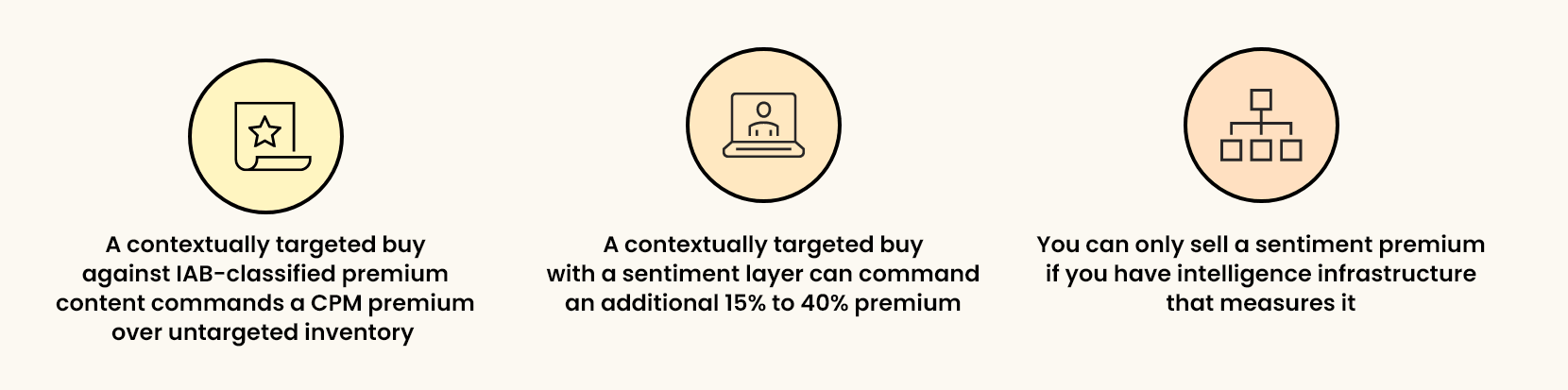
Premium CPMs are no longer driven by audience demographics alone. Advertisers increasingly want confidence that their campaigns appear in environments that reinforce the message they’re trying to deliver.
That’s where sentiment intelligence creates a measurable advantage. This enables publishers to move beyond traditional contextual advertising, offering advertisers greater confidence that campaigns appear in emotionally appropriate environments. Improved contextual targeting enables publishers to package inventory around emotional relevance rather than content category alone.
Instead of matching advertisements to broad content categories, publishers can demonstrate the emotional context surrounding every impression – helping advertisers understand not just where an ad will appear, but why that placement is likely to perform better.
This changes the commercial conversation. Publishers are no longer selling inventory alone—they are selling measurable advertising context.
Rather than selling inventory based solely on audience reach or content genre, publishers can offer emotionally aligned advertising environments backed by measurable insights. That creates stronger differentiation, supports premium pricing, and gives advertisers greater confidence in their media investments.
As contextual advertising continues to evolve, publishers that can quantify emotional context will compete on the quality of their intelligence – not simply the scale of their inventory.
From Brand Safety to Brand Suitability
Brand safety ensures advertisements appear in appropriate environments. Today, that’s expected.
Brand suitability goes a step further by helping advertisers identify environments that actively support the goals of their campaigns.
As contextual advertising continues to evolve, advertisers are increasingly looking beyond keyword-based targeting toward emotionally aligned advertising experiences.
Trust matters most to a financial brand. Ambition drives an automotive brand. Optimism and celebration define a consumer goods brand.
These aren’t subjective creative choices – they’re measurable characteristics of the content itself.
With sentiment intelligence, publishers can identify these emotional environments, package them into differentiated inventory, and help advertisers make more informed placement decisions before campaigns even begin.
Brand safety protects advertising value. Brand suitability is what increases it — and as third-party data keeps eroding, it may be one of the more durable advantages a publisher can build.
As advertisers continue investing in contextual advertising and privacy-first strategies, the ability to measure emotional alignment is becoming an increasingly important competitive advantage for publishers.
Why Cookieless Advertising Rewards Emotional Context
As third-party cookies continue to disappear, publishers are rethinking how they differentiate inventory without relying on individual user tracking.
This shift is accelerating the move toward privacy-first advertising, where first-party relationships and content intelligence become the foundation of media monetization.
Unlike behavioral targeting, emotional context doesn’t depend on personal identifiers or cookies. It is derived directly from the content itself, making it scalable, privacy-friendly, and future-ready.
For publishers, this presents an opportunity to create richer, more valuable advertising experiences while giving brands greater confidence in where – and how – their messages appear.
As contextual advertising continues to evolve, publishers that can measure and monetize emotional context will be better positioned to differentiate their inventory, strengthen advertiser trust, and unlock long-term revenue growth.
Publishers that embrace contextual advertising powered by emotional intelligence will be better positioned to create premium inventory and stronger advertiser relationships.
The future of publisher monetization won’t be defined by audience reach alone. It will be shaped by how well publishers understand, package, and commercialize the emotional experiences surrounding every impression.
As advertisers increasingly prioritize brand suitability over basic brand safety, publishers that combine emotional context with contextual advertising strategies will be better positioned to increase premium CPMs, strengthen advertiser trust, and drive sustainable publisher monetization.
Brand suitability is becoming an important driver of long-term publisher monetization, helping publishers maximize inventory value without compromising advertiser trust.
Ready to unlock the commercial value of emotional context?
Built on the Databricks Data Intelligence Platform, Infocepts' SentimentVista AI enables publishers to operationalize brand suitability and contextual advertising at enterprise scale. Learn how Infocepts helps media organizations transform contextual advertising and publisher monetization through AI-powered sentiment intelligence.
Recent Blogs



Infocepts