
Every broadcaster has a version of the same story. The one where a major tentpole event – the Super Bowl, the Olympics, the Oscars, the NCAA Tournament – went sideways in a way that cost real money and real relationships.
The details differ. Sometimes it’s an ad server buckling under peak load. Sometimes it’s delivery pacing that quietly falls off on day three of a five-day event, and nobody catches it until the agency calls. Sometimes it’s inventory from a three-month-old make-good colliding with a premium placement that was supposed to sell at full CPM.
At the center of almost every version of this story sits the same root cause: revenue optimization systems that weren’t built to hold up in real time, under the exact conditions they were designed for.
The common thread isn’t technical failure. It’s the absence of intelligence at the exact moment it was needed most.
Tentpole events are where the ad sales business gets made or broken. Revenue is at its highest, client relationships are at their most exposed, and operational complexity is at its most extreme – with zero margin for error, because there’s no time to recover once the event is live.
What 250% Data Volume Actually Means
During the Paris Olympics, the broadcaster we support processed roughly 250% of normal daily data volume during peak coverage windows. In practical terms, that’s 250% of the impression events, targeting lookups, audience signal processing, pacing checks, and measurement flows that run through the system on a normal broadcast day.
Most ad technology stacks are engineered for average load – capacity-planned around normal conditions with some headroom for peaks. A tentpole event doesn’t produce a modest peak. It produces a sustained, multi-day surge that stress-tests every part of the infrastructure at once.
Here’s what actually happened on the infrastructure we manage during Paris 2024: the platform scaled automatically, with no manual intervention. EMR Serverless auto-scaled compute to match demand. Data pipelines held peak throughput without degrading. Delivery data reached the operations team 60 minutes ahead of SLA – not at SLA, ahead of it.
Zero SLA breaches. Zero delivery incidents escalated to client communication. Zero emergency ops calls at 2 a.m.
That’s what intelligence-driven tentpole readiness looks like. Not heroic effort from a war room — systematic readiness that keeps the war room quiet.
The Three Risks Revenue Optimization Teams Don’t Model
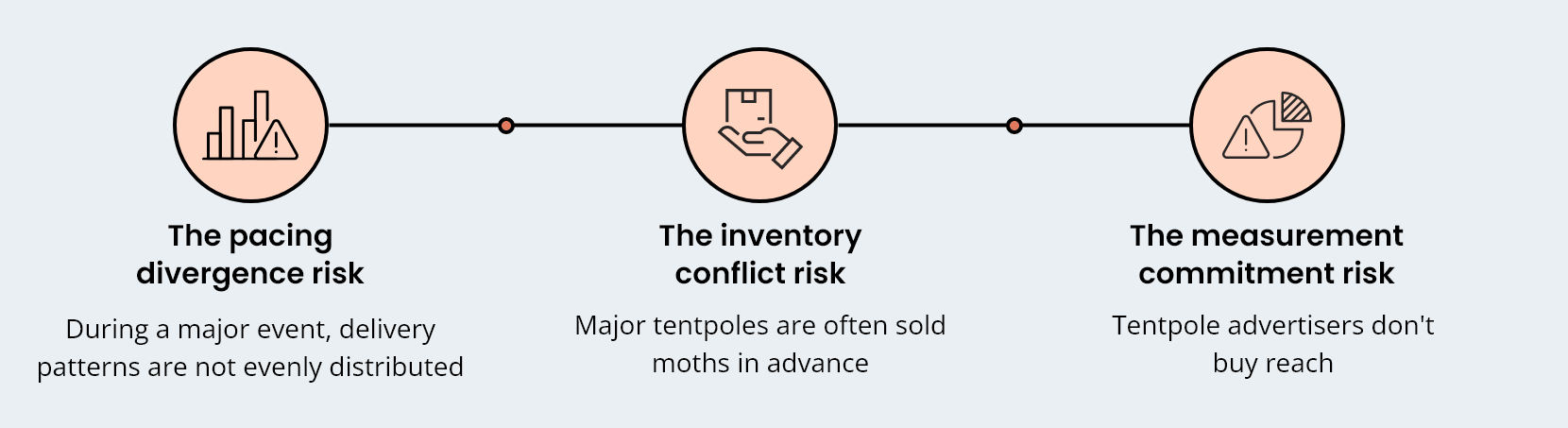
When publishers think about tentpole risk, they usually think about platform stability. That’s real risk. But the most expensive tentpole failures come from three risks that are less visible and less often modeled.
The pacing divergence risk – Delivery during a major event is never evenly distributed. Audience composition shifts by daypart, by market, by device – a campaign targeted against one demographic profile might deliver efficiently in primetime and fall off completely in daytime windows. Without real-time pacing intelligence, that divergence doesn’t surface until the event is over, when there’s nothing left to recover. This is precisely the gap CampaignNova is built to close – flagging delivery health and pacing drift in real time, while there’s still room to correct course.
The inventory conflict risk – Tentpoles typically sell months in advance, but the inventory map keeps shifting between the sale and the event itself – make-goods get allocated, deals get revised, packages get restructured. Without continuous reconciliation between committed inventory and available positions, conflicts surface during the event, when there’s no graceful way to resolve them. This is exactly where a real-time ad inventory management layer earns its keep, and it’s the problem Inventory Optimisation Multiplier was purpose-built to solve – reconciling commitments against availability on a continuous cycle instead of a nightly batch job.
The measurement commitment risk – Tentpole advertisers aren’t buying reach – they’re buying guaranteed audience delivery, validated by real-time measurement. If measurement data lags during the event, the guarantee conversation with the agency happens on incomplete information. That’s where disputes start. This is where AdSentinel fits – continuously monitoring ad integration health across every endpoint so measurement gaps surface as alerts, not agency phone calls.
How Real-Time Monitoring Changes Each Risk
Real-time pacing intelligence catches divergence within hours of onset – the operations team gets notified when a campaign is tracking below commitment before the deviation becomes material. The fix happens before the client ever knows there was a problem. That’s operational intelligence doing its job: turning a lagging indicator into a live one.
Automated inventory reconciliation, running continuously, flags conflicts as they emerge and surfaces resolution options before they become delivery failures. The yield team knows in real time what’s committed, what’s available, and where the pressure points sit – the practical core of modern yield management for live events.
And measurement infrastructure that clears SLA ahead of schedule turns the agency conversation proactive instead of reactive. The guarantee reconciliation happens with complete information, not a scramble to explain a gap after the fact. This is what revenue intelligence actually looks like in practice – not a dashboard reviewed after the event, but a system that protects the number while the event is still live.
The Super Bowl Lesson for Linear TV Advertising
The Super Bowl is the highest-revenue single event in linear TV advertising. The cost of operational failure during it – reputational damage, relationship cost, make-good obligations – reflects that premium in the downside case just as much as the upside.
Publishers who run the Super Bowl successfully, year after year, aren’t doing it through heroic manual effort. They’re doing it through systematic readiness – infrastructure engineered for peak load, intelligence layers monitoring the full stack in real time, and operations teams watching events unfold instead of reacting after the fact.
That readiness doesn’t happen by accident. It’s built, tested, and validated in the off-season. The events team at a major broadcaster doesn’t discover their pacing model is wrong during the fourth quarter of the Super Bowl. They find out during a test event in October.
Building Tentpole Readiness with Operational Intelligence
The conversation worth having with any publisher heading into a major tentpole isn’t about technology gaps. It’s about intelligence gaps – the places where real-time data isn’t reaching the right decision-makers at the right moment, where manual processes are doing work automated monitoring should be doing, where the first signal of a delivery problem is a phone call from the agency instead of an alert from your own system.
Those gaps are findable before the event. They’re manageable before the event. They’re nearly impossible to fix once it’s live.
Broadcasters who’ve built tentpole intelligence into their operations don’t think of the Super Bowl as a risk to survive. They think of it as a revenue opportunity their systems are built to capture. That’s a fundamentally different posture – and it produces fundamentally different results.
Recent Blogs

Why Pharma Commercial Teams Have a Data Problem – Not an Analytics Problem
July 9, 2026

15% Lower Costs and 20% Faster Delivery in 8 Months: The Business Case for an AI-Ready Supply Chain Data Platform
July 7, 2026

Your AI Vendor Is Selling You a Dashboard. Here’s What Real Sales Intelligence Software Actually Looks Like.
July 2, 2026
Infocepts